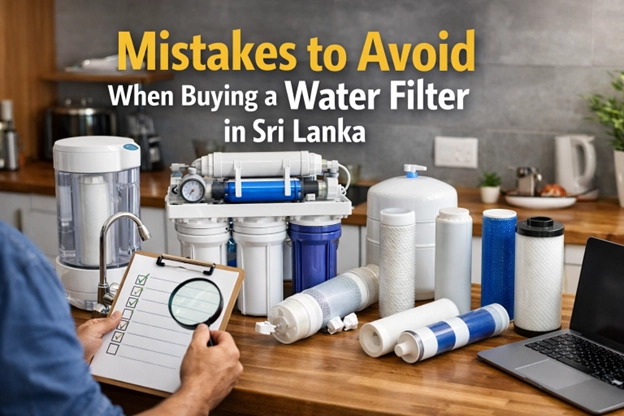
Access to clean and safe drinking water is essential for health, especially in Sri Lanka where water quality can vary significantly depending on location, water source, infrastructure, and environmental conditions. Many households invest in water filters expecting pure, safe drinking water- but choosing the wrong system can result in wasted money, poor filtration, maintenance problems, or even unsafe water.
This guide explains the most common mistakes people make when buying a water filter in Sri Lanka, why those mistakes matter, and how to choose the right filtration system based on your specific needs. This article is structured to help homeowners, renters, offices, and businesses make informed decisions that ensure long-term water safety and value.
Before discussing mistakes, it's important to understand that Sri Lanka’s water quality varies by region and source. The most common water sources include:
Each source can contain different contaminants, including:
Because of these variations, there is no universal “best water filter.” The correct choice depends on your water quality, usage, and environment.
One of the biggest mistakes is purchasing a water filter without knowing what contaminants are present.
Many people assume all filters do the same job, but different filtration technologies target different impurities.
If you buy the wrong type of filter:
If your water contains high dissolved solids (TDS), a simple UV filter will not remove them. Only an RO (Reverse Osmosis) system can reduce dissolved salts effectively.
Understanding your water quality ensures you select the correct filtration technology.
Price is an important factor, but choosing the cheapest water filter often leads to poor performance and higher long-term costs.
Low-quality filters often have:
Cheap systems may fail to remove bacteria or dissolved contaminants effectively.
A reliable water filter provides:
Investing in a quality system initially can reduce costs over several years.
Many buyers do not understand the differences between RO, UV, and UF filtration technologies.
Each serves a specific purpose.
Best for removing:
Suitable for:
Best for removing:
Suitable for:
Best for removing:
Often used as a pre-filter or in low contamination areas.
Choosing the wrong technology can leave contaminants untreated.
Water pressure plays a critical role in filter performance.
RO systems require sufficient pressure to function properly. Low pressure can result in:
Many Sri Lankan homes experience low water pressure, especially in:
Choose a filter with a built-in booster pump if pressure is low.
All water filters require regular maintenance.
Ignoring maintenance leads to:
Maintenance frequency varies based on:
Reliable brands like PureHydro design systems with accessible maintenance and readily available spare parts.
Water filter capacity determines how much water can be purified daily.
Choosing insufficient capacity leads to:
Typical consumption per household ranges between 10–25 liters per day.
Selecting the correct capacity ensures smooth operation.
Even the best water filter will fail if installed incorrectly.
Common installation mistakes include:
Professional installation ensures:
Certified water filters undergo safety and performance testing.
Low-quality filters may:
Look for systems with recognized certifications and quality assurance.
Reliable manufacturers and suppliers ensure compliance with safety standards.
Many buyers focus only on initial purchase cost and ignore replacement costs.
Important ongoing costs include:
A low upfront cost system may have expensive replacement parts.
Understanding total ownership cost helps avoid future financial burden.
Your water source determines the correct filtration solution.
Usually contains chlorine and microorganisms.
Best solutions:
Often contains:
Best solution:
May contain:
Best solution:
Choosing based on water source ensures effective purification.
Unreliable brands often lack:
This leads to:
Trusted providers like PureHydro offer reliable systems designed for Sri Lankan water conditions.
Pre-filters remove sediment and protect main filtration components.
Without pre-filtration:
Pre-filtration improves overall performance.
Water filters require proper installation space.
Consider:
Choosing the right size ensures convenient installation.
Water filters require proper flushing and setup before full performance.
Initial flushing removes:
Following setup procedures ensures optimal performance.
Each component has a specific lifespan.
Typical lifespans:
Ignoring replacement schedules reduces effectiveness.
Follow these steps:
These steps ensure safe and effective water purification.
A properly selected water filter provides:
Clean water improves health and overall quality of life.
If your water has high TDS, hardness, or comes from wells, RO filtration is recommended.
UV removes microorganisms but does not remove dissolved salts or heavy metals.
How often should filters be replaced?
Typically every 6 -12 months, depending on usage and water quality.
Yes, UV and RO filters effectively remove bacteria.
Buying a water filter is an important investment in your health and safety. Avoiding common mistakes - such as choosing the wrong filtration technology, ignoring maintenance, or selecting low-quality systems - ensures long-term performance and reliable water purification.
Understanding your water quality, choosing the correct filter type, and maintaining the system properly are essential steps.
A well-chosen water filtration system provides safe, clean drinking water for years, protecting your household and improving overall wellbeing.